

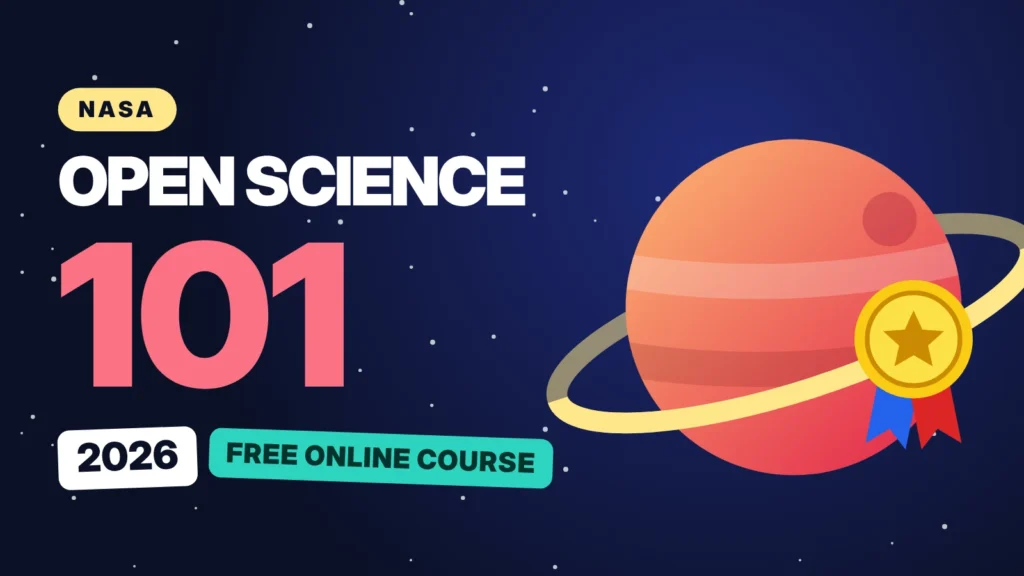
NASA offers a free course on open science, and many websites list it as “NASA Open Science Essentials.” The two names refer to different things, and the difference matters if you want a course you can start today.
This guide covers both, using NASA’s own TOPS page and the conference listing for the Essentials workshop.
Open Science 101: the self-paced course
NASA’s Transform to Open Science (TOPS) programme runs Open Science 101. According to the TOPS page, it is:
- Free
- Self-paced
- Made of five modules, each about two hours long
- Enrolled through the TOPS GitHub site (go.nasa.gov/40pPQMx)
When you complete it, you earn a NASA Open Science digital badge through Credly. The badge doesn’t expire. If it doesn’t arrive after 48 hours, TOPS asks you to write to support@openscience101.org.
What about Open Science Essentials?
Open Science Essentials is a three-hour workshop, not a self-paced online course. NASA ran it at FOSS4G NA 2026 on 4 November 2026, from 1:00 to 4:00 PM.
The conference page describes it as “a concise, stand-alone workshop for learners seeking a broad overview of open science concepts.” Participants who complete it get a NASA digital badge and certificate they can add to their ORCID profile.
That session has already happened. The page also encourages participants to continue with Open Science 101. We didn’t find a way to take Essentials online on demand, so check the TOPS site for future workshops.
What the Essentials workshop covered
The workshop outline gives a good idea of the topics:
- Why open science matters for researchers and the wider community
- Common concerns, such as being scooped, institutional barriers and sensitive data
- Planning with the FAIR principles and an Open Science and Data Management Plan
- Core parts: open data, open-source software and open results
- Tools such as persistent identifiers, open licences, repositories, version control and pre-registration, and the role of AI
We couldn’t read Open Science 101’s own module list, so these topics are a guide and may not match the course exactly.
Is the certificate worth it?
You get a digital badge, not a university certificate or a degree credit. It shows you completed NASA’s training and can be added to a CV or LinkedIn profile. Don’t expect it to replace a formal qualification.
Who it suits
Students, researchers, librarians and anyone who works with data or research outputs. The pages we read don’t list prerequisites or a required level.
How to enrol
- Open the TOPS Open Science 101 link (go.nasa.gov/40pPQMx).
- Follow the instructions to sign up on the TOPS GitHub site.
- Complete all five modules.
- Check your email for the Credly badge.
Contacts (from the TOPS page)
- General questions: hq-openscience@nasa.gov
- Badge not received after 48 hours: support@openscience101.org
- Errors in course content: arc-openscience101@mail.nasa.gov



Comments